A collection of ancient site photographs from the archive.
Parthenon
Temple of Athena
Country: Greece
Date: 2023
Place: Athens
Constructed between 447 BC and 432 BC
High Classical Doric style
Designed by Iktinos and Callicrates
!UNESCO World Heritage site, an enduring symbol of ancient Greek civilization
The Parthenon was built in thanksgiving for the Greek victory over the Persian invaders during the Greco-Persian Wars.
Brazen Palace
Lovamahapaya
Country: Sri Lanka
Date: 2023
Place: Anuradhapura
Built between 161 BCE and 137 BCE
Ancient multi-storey timber (stone foundation) style
!UNESCO World Heritage Site. Originally a nine-story, reaching up to 50 m and measured 120 m on each site, 1,000-room monastery with a bronze-tiled roof, it was the tallest building in the region for centuries.
Is an ancient, historically significant site built by King Dutugemunu. Today, it consists of 1,600 stone columns.
Pillers of Thuparamaya
Thuparamaya Buddhist temple
Country: Sri Lanka
Date: 2023
Place: Anuradhapura
Built in the 3rd century BCE (circa 247–207 BCE or 250–210 BCE)
Dhanyakara shape (resembling a heap of paddy/rice) style
Designed by or more precisely spiritual guidance by Arahant Mahinda Thera (the son of Indian Emperor Ashoka who introduced Theravada Buddhism to Sri Lanka)
!UNESCO World Heritage Site. The earliest documented Buddhist temple in Sri Lanka.
Located within the sacred precinct of Mahamewna park, the Thuparamaya Stupa is the earliest Dagoba to be constructed on the island.
Po Nagar Temple
Entry way to Po Nagar temple
Country: Vietnam
Date: 2013
Place: Nha Trang
Rebuilt around 770–787 AD
Champa architecture with heavy Hindu influences style
!Second level with 22 octagonal pillers.
A stele dated 781 CE indicates that the Cham King Satyavarman regained power in the area of "Ha-Ra Bridge", and that he restored the devastated temple.
Po Nagar Temple
Po Nagar temple
Country: Vietnam
Date: 2013
Place: Nha Trang
Rebuilt around 770–787 AD
Champa architectural art style
!The temple existence is prior to 781 CE, as that date refers to the repair of the temple by the King after it was robbed of its valuable jewellery by foreign fighters.
The Cham King Satyavarman regained power in the area of "Ha-Ra Bridge", and that he restored the devastated temple.
My Son Sanctuary
My Son sanctuary
Country: Vietnam
Date: 2013
Place: My Son
Built and expanded between the 4th century and the 13th century AD
Cham architectural style
!UNESCO World Heritage Site.
Constructed by the Kings of Champa as a unique culture which owed its spiritual origins to Indian Hinduism developed on the coast of contemporary Viet Nam.
Erechtheion
The Caryatid Porch of the Acropolis
Country: Greece
Date: 2023
Place: Athens
Built between 421 BC and 405 BC
Ionic order style
Designed by Mnesikles is widely credited by historical sources but others suggesting Kallikrates or Iktinos
!Part of the Acropolis UNESCO World Heritage Site.
Its most famous feature is the Porch of the Caryatids, where sculpted female figures serve as architectural columns.
Erechtheion Side View
Temple of Athena and the Caryatids
Country: Greece
Date: 2023
Place: Athens
Carved circa 420–415 BCE
High Classical Greek art style
Designed by and carved by workshop of the sculptor Alcamenes (a student of Phidias)
!Part of the Acropolis UNESCO World Heritage Site.
A side view of the Erechtheion revealing the temple’s asymmetrical design. Built on uneven ground atop the Acropolis, the structure was dedicated to Athena and Poseidon and housed several important religious shrines of ancient Athens.
Parthenon Detail
Ancient Greek Architecture on the Acropolis
Country: Greece
Date: 2023
Place: Athens
Constructed between 447 BC and 432 BC
High Classical Doric style
Designed by Iktinos and Callicrates
!Optical Illusions: The Parthenon contains virtually no straight lines or right angles. Its stylobate (base) curves upward and columns lean slightly inward so the massive structure appears straight and symmetrical to the human eye.
A close view of the Parthenon, the most celebrated monument of Classical Greece. Dedicated to Athena and remains one of the most influential buildings in world architecture.
Gal Viharaya
Rock-Cut Buddha Statues of Polonnaruwa
Country: Sri Lanka
Date: 2023
Place: Polonnaruwa
Built in 12th century AD
Ancient Sinhalese sculpture heavily influenced by the Amaravati school of art from South India as a carving style
!Part of the Ancient City of Polonnaruwa UNESCO World Heritage Site.
Gal Viharaya is one of the masterpieces of Sri Lankan rock carving. Created during the reign of King Parakramabahu I, it contains four monumental Buddha statues carved from a single granite outcrop 27 m long and 10 m high.
Council Chamber of King Parākramabāhu I
Royal Administrative Hall
Country: Sri Lanka
Date: 2023
Place: Polonnaruwa
Built in 12th century AD
Classical medieval Sinhalese style
!Part of the Ancient City of Polonnaruwa UNESCO World Heritage Site.
The Council Chamber is believed to have served as a royal audience hall during the reign of King Parakramabahu I. Stone columns and carved elephant balustrades remain among its most distinctive features.
Council Chamber of King Parākramabāhu I - Colonnade
Stone Pillars of the Royal Administrative Hall
Country: Sri Lanka
Date: 2023
Place: Polonnaruwa
Built in 12th century AD
Classical medieval Sinhalese style
!Part of the Ancient City of Polonnaruwa UNESCO World Heritage Site.
48 of these columns once supported a timber roof above a royal administrative hall where state affairs and ceremonial gatherings were conducted.
Council Chamber of King Parākramabāhu I - Lion Guardstones
Ceremonial Entrance to the Royal Administrative Hall
Country: Sri Lanka
Date: 2023
Place: Polonnaruwa
Built in 12th century AD
Classical medieval Sinhalese style
!Part of the Ancient City of Polonnaruwa UNESCO World Heritage Site.
Stone lions flank the ceremonial entrance to the Council Chamber. Such guardian figures symbolised royal authority and protected important civic and religious structures throughout the Polonnaruwa Kingdom.
Kumara Pokuna
Ancient Royal Bathing Pool
Country: Sri Lanka
Date: 2023
Place: Polonnaruwa
Built in 12th century AD
Classical medieval Sinhalese style
!Part of the Ancient City of Polonnaruwa UNESCO World Heritage Site.
Kumara Pokuna is an elegantly engineered bathing pool built for members of the royal court. Its stone-lined walls and sophisticated water management demonstrate the advanced hydraulic knowledge of ancient Sri Lanka.
Nelum Pokuna
Lotus-Shaped Ritual Pond
Country: Sri Lanka
Date: 2023
Place: Polonnaruwa
Built in 12th century AD
Modeled as a stylised, eight-petalled lotus flower in full bloom style
!Outer diameter 7.54 m and 1.37 m of depth. Part of the Ancient City of Polonnaruwa UNESCO World Heritage Site.
One of the most distinctive hydraulic structures in Polonnaruwa. Built in the form of a lotus flower, it reflects the symbolic and engineering achievements of the medieval kingdom.
Lankatilaka Image House
Monumental Shrine of Polonnaruwa
Country: Sri Lanka
Date: 2023
Place: Polonnaruwa
Built in 12th century AD
Gedi-ge style
Designed by Believed to be Sthapati Rayar
!Reaches over 17 m high. Part of the Ancient City of Polonnaruwa UNESCO World Heritage Site.
Lankatilaka is the largest image houses build in ancient Sri Lanka. Built during the reign of King Parakramabahu I, its towering brick walls once enclosed a colossal standing Buddha statue.
Standing Buddha of Lankatilaka
Remains of a Colossal Image House
Country: Sri Lanka
Date: 2023
Place: Polonnaruwa
Built in 12th century AD
Gedi-ge style
Designed by Believed to be Sthapati Rayar
!The Buddha built from specially manufactured clay bricks and originally reaching about 12.5 to 14 m. Part of the Ancient City of Polonnaruwa UNESCO World Heritage Site.
The surviving lower portion of a monumental standing Buddha remains within the towering walls of Lankatilaka. The original statue dominated the interior of the sanctuary.
Ancient Restoration Work
Structural Supports Within Lankatilaka
Country: Sri Lanka
Date: 2023
Place: Polonnaruwa
Built in 12th century AD
Gedi-ge style
Designed by Believed to be Sthapati Rayar
!Part of the Ancient City of Polonnaruwa UNESCO World Heritage Site.
Ancient masonry and modern conservation work meet inside the Lankatilaka complex. Reinforced supports help stabilise sections of the monument while preserving one of the most important architectural achievements of medieval Sri Lanka.
Hevisi Mandapaya
Ancient Drum Hall of Polonnaruwa
Country: Sri Lanka
Date: 2023
Place: Polonnaruwa
Built in 12th century AD
Polonnaruwa Period style
!Features key historical and architectural details. Part of the Ancient City of Polonnaruwa UNESCO World Heritage Site.
The Hevisi Mandapaya served ceremonial and religious functions within the sacred city. Its carved stonework and elevated platform remain important examples of medieval Sinhalese architecture.
Menik Vehera
Restored brick stupa
Country: Sri Lanka
Date: 2023
Place: Polonnaruwa
Original construction to the 8th to 9th centuries CE
Bridging between the classic Anuradhapura and Polonnaruwa design traditions style
!One of the largest stupas of the Polonnaruwa period.
Menik Vehera is one of the largest stupas in Polonnaruwa. Built during the reign of King Parakramabahu I, it once stood as a major religious monument within the Alahana Pirivena monastic complex.
Nissanka Lata Mandapa
Royal pavilion of King Nissanka Malla
Country: Sri Lanka
Date: 2023
Place: Polonnaruwa
Built during the second half of the 12th century
Ancient Sri Lankan stone architecture style
!Unique architectural style found nowhere else in the country.
This unique stone pavilion was built by King Nissanka Malla. The lotus-stem columns curve gently inward and are unlike any other architectural feature found in Sri Lanka.
Atadage Image House
Ruins beside the Velaikkara Inscription
Country: Sri Lanka
Date: 2023
Place: Polonnaruwa
12th century CE
Ancient Sri Lankan stone architecture style
!Located near the famous Velaikkara Inscription, which records the protection of the Temple of the Tooth Relic.
Stone pillars, carved columns and brick foundations surround the area near the Velaikkara Inscription. These remains formed part of the ceremonial and administrative buildings associated with the Sacred Quadrangle during the Polonnaruwa Kingdom.
Velaikkara Inscription
Ancient Tamil inscription
Country: Sri Lanka
Date: 2023
Place: Polonnaruwa
12th century CE
Designed by The Vēḷäikkāṟa (Velaikkara) community
!Important historical record of military and religious administration from 12th century.
The Velaikkara Inscription records an agreement made by Tamil mercenary soldiers to protect the sacred Temple of the Tooth Relic during the reign of King Vijayabahu I.
Pothgul Viharaya
Ancient library monastery
Country: Sri Lanka
Date: 2023
Place: Polonnaruwa
12th century CE
Gedige style
!Part of the Ancient City of Polonnaruwa UNESCO World Heritage Site.
Pothgul Viharaya is believed to have served as a monastery and library where Buddhist manuscripts were studied and preserved. The circular structure is one of the most distinctive monuments in Polonnaruwa.
Royal Palace Entrance
Gateway to the royal residence
Country: Sri Lanka
Date: 2023
Place: Polonnaruwa
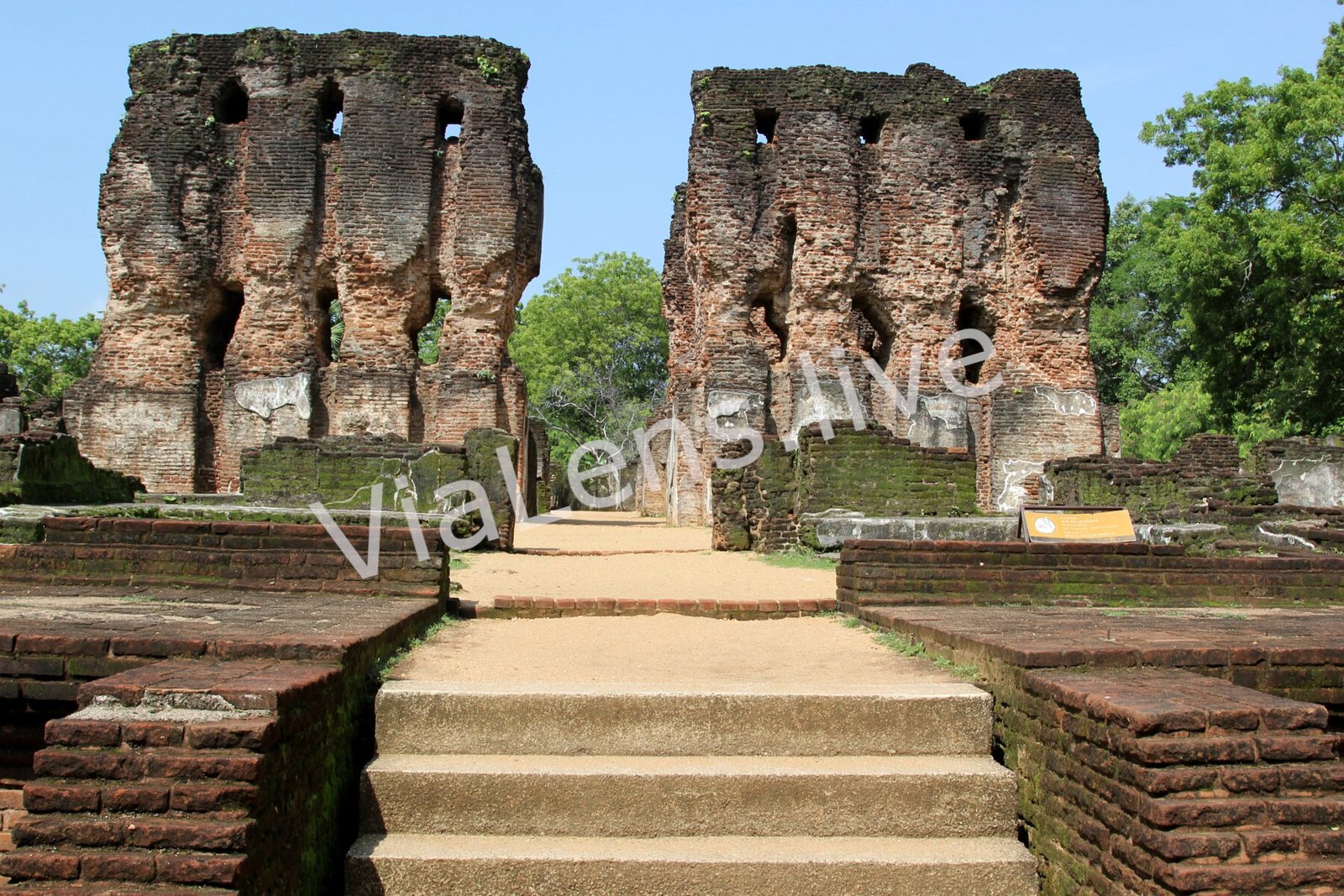
Built in the 12th century
Ancient Polonnaruwa / medieval Sinhalese royal architecture style
!Three stories out of seven original once can be identify. Part of the Ancient City of Polonnaruwa UNESCO World Heritage Site.
Decorated guardstones and a stone stairway mark the entrance to the Royal Palace complex built by King Parakramabahu I, once one of the grandest royal buildings in South Asia.
Sathmahal Prasada
Seven-storeyed pyramid shrine
Country: Sri Lanka
Date: 2023
Place: Polonnaruwa
Built in the 12th century
Foreign-influenced South-East Asian style
!Rare example of foreign architectural influence in medieval Sri Lanka.
Sathmahal Prasada is an unusual stepped monument believed to have been inspired by Cambodian or Southeast Asian architectural traditions. Its seven diminishing levels make it unique in Sri Lanka.
Shiva Devale No. 2
Hindu temple of Polonnaruwa
Country: Sri Lanka
Date: 2023
Place: Polonnaruwa
Built in the early 11th century (around 993–1014 CE)
Dravidian architecture style
!The oldest Hindu shrine in Polonnaruwa.
Constructed from granite blocks, Shiva Devale No. 2 is among the best-preserved Hindu temples in Sri Lanka and reflects the strong South Indian influence during the medieval period.
Polonnaruwa Vatadage
Circular relic house
Country: Sri Lanka
Date: 2023
Place: Polonnaruwa
Built in the 12th century
A unique architectural style
!One of the finest surviving examples of a Vatadage in Sri Lanka.
The Vatadage is considered one of the masterpieces of Sinhalese architecture. It was built to protect sacred relics and features beautifully carved stone guardstones, moonstones and stairways.
Vatadage Stone Stairway
Decorated entrance steps
Country: Sri Lanka
Date: 2023
Place: Polonnaruwa
Built in the 12th century
A unique architectural style
!Part of the Ancient City of Polonnaruwa UNESCO World Heritage Site.
The entrance staircase of the Vatadage is richly decorated with carvings of dwarfs, lotus motifs and guardian figures, showcasing the exceptional stone craftsmanship of the Polonnaruwa era.
Vatadage Buddha Shrine
Sacred centre of the relic house
Country: Sri Lanka
Date: 2023
Place: Polonnaruwa
Built in the 12th century
A unique architectural style
!Part of the Ancient City of Polonnaruwa UNESCO World Heritage Site.
Viewed through the surrounding columns, the seated Buddha occupies the sacred centre of the Vatadage, where relics and religious ceremonies were once protected by the circular structure.
Stone Inscription Slab
Medieval inscription panel
Country: Sri Lanka
Date: 2023
Place: Polonnaruwa
Late 12th century
!Part of the Ancient City of Polonnaruwa UNESCO World Heritage Site.
Large inscribed stone slabs such as this preserved royal decrees, donations, and administrative records. They provide historians with valuable evidence about governance and daily life in medieval Sri Lanka.
Sacred Quadrangle Ruins
Monastic Foundations
Country: Sri Lanka
Date: 2023
Place: Polonnaruwa
Late 12th century
Classical ancient Sri Lankan Buddhist stupa (dagoba) style
!Two-Storey Structure where the ground floor served as a stone shrine, while the upper wooden floor securely housed the Sacred Tooth Relic of the Buddha. Part of the Ancient City of Polonnaruwa UNESCO World Heritage Site.
Built during the reign of King Nissanka Malla. Brick foundations and stone platforms mark the remains of religious and residential buildings within the Sacred Quadrangle, once the spiritual heart of the medieval capital. Measuring approximately 37 m long and 27 m wide.
Monastic Ruins
Stone Structures of Polonnaruwa
Country: Sri Lanka
Date: 2023
Place: Polonnaruwa
Cholas first used Polonnaruwa as a stronghold in 993 AD
!Part of the Ancient City of Polonnaruwa UNESCO World Heritage Site.
Carved stone foundations, decorative mouldings, and surviving wall sections reveal the architectural sophistication of the monastic compounds built during the Polonnaruwa Kingdom.
Ancient Monastic Courtyard
Residential Monastery Remains
Country: Sri Lanka
Date: 2023
Place: Polonnaruwa
Built in the 12th century
Traditional medieval Sinhalese stone architecture style
!Illustrates the organised layout of medieval Sinhalese kingdoms.
The remaining stone walls and foundations outline rooms, courtyards, and meditation spaces once occupied by monks serving the royal capital.
Rows of stone pillars mark the foundations of a residential building once occupied by Buddhist monks. Wooden structures originally rested on these columns, forming part of a large monastic community.
Ath Pokuna
The Ath Pokuna (Elephant Pond)
Country: Sri Lanka
Date: 2023
Place: Anuradhapura
Built around the 2nd century BCE to 1st century CE
!Measuring 159 m long, 52.7 m wide and 9.5 m deep. Part of the Sacred City of Anuradhapura UNESCO World Heritage Site.
An ancient stone-lined bathing pond within the sacred city of Anuradhapura. These reservoirs formed part of a sophisticated hydraulic system that supplied water to monasteries, pilgrims, and residents of one of the longest continuously inhabited capitals of the ancient world.
Abhayagiri Vihara
Monastic Complex of Ancient Anuradhapura west direction
Country: Sri Lanka
Date: 2023
Place: Anuradhapura
Specific entry structures, staircases, and stone carvings like guardstones and moonstones were refined through subsequent centuries (notably the 5th to 8th centuries CE
Anuradhapura monastic style
!Part of the Sacred City of Anuradhapura UNESCO World Heritage Site.
Founded in the 1st century BC, Abhayagiri became one of the greatest monastic centres of the Buddhist world. Pilgrims and scholars travelled here from across Asia to study and worship.
Abhayagiri Vihara
Great Monastic Stupa
Country: Sri Lanka
Date: 2023
Place: Anuradhapura
Founded 89–77 BCE
Ancient Sinhalese centric monastery layout style
!Abhayagiri Dagaba was one of the largest brick structures ever built in the ancient world and stood 115 - 122 m tall.
It became the centre of the influential Abhayagiri monastic fraternity and attracted monks from across Asia.
Mirisawetiya Dagoba
Stupa of King Dutugemunu
Country: Sri Lanka
Date: 2023
Place: Anuradhapura
Founded 2nd century BCE
Classical ancient Sri Lankan Buddhist stupa (dagoba) style
!One of the earliest major Buddhist stupas in Sri Lanka. High 59 m and diameter 43 m
Mirisawetiya was built by King Dutugemunu. According to tradition, the king accidentally left a sacred relic embedded in his spear at this site and subsequently constructed the stupa around it.
Ancient Stone Rice Canoe
Granary Eating Vessel
Country: Sri Lanka
Date: 2023
Place: Anuradhapura
Dating up to the 10th century CE
!It is roughly 19 meters and was designed to hold enough cooked rice for roughly 5,000 monks.
Known locally as the Rice Boat or Rice Canoe, this massive stone trough to hold and serve cooked rice to thousands of Buddhist monks.
Kuttam Pokuna
Ancient Twin Ponds
Country: Sri Lanka
Date: 2023
Place: Anuradhapura
Dating from roughly the 6th to 10th centuries CE
!Part of the UNESCO World Heritage Site of Ancient Anuradhapura. The ponds date from around the 8th century and are regarded as masterpieces of ancient water engineering.
One of the ancient bathing ponds of Kuttam Pokuna in Anuradhapura. These finely engineered stone reservoirs were constructed by the monks of the Abhayagiri Monastery and demonstrate the advanced hydraulic and architectural skills of ancient Sri Lanka. Nothern Pond 28 m long and 16 m wide and Southern Pond is 40 m long and 16 m wide.
New addition
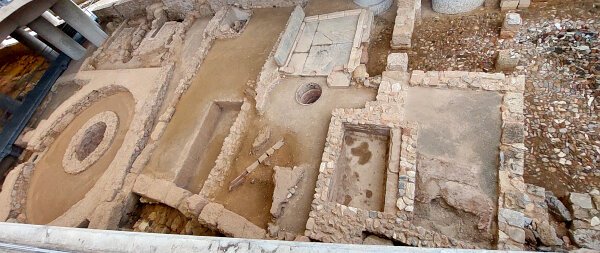
Ancient Settlement Beneath Acropolis Museum
Excavated remains of an ancient Athenian neighbourhood
Country: Greece
Date: 2023
Place: Acropolis Museum, Athens
4th Millennium BC first evidence of human activity
!The modern Acropolis Museum stands on columns above the archaeological remains, allowing visitors to explore the ancient neighbourhood beneath it.
Archaeological excavations beneath the Acropolis Museum reveal the remains of an ancient Athenian neighbourhood, including building foundations, courtyards, drainage systems and domestic installations. The excavated settlement preserves evidence of everyday life across several historical periods, from antiquity into the Byzantine era.
New addition
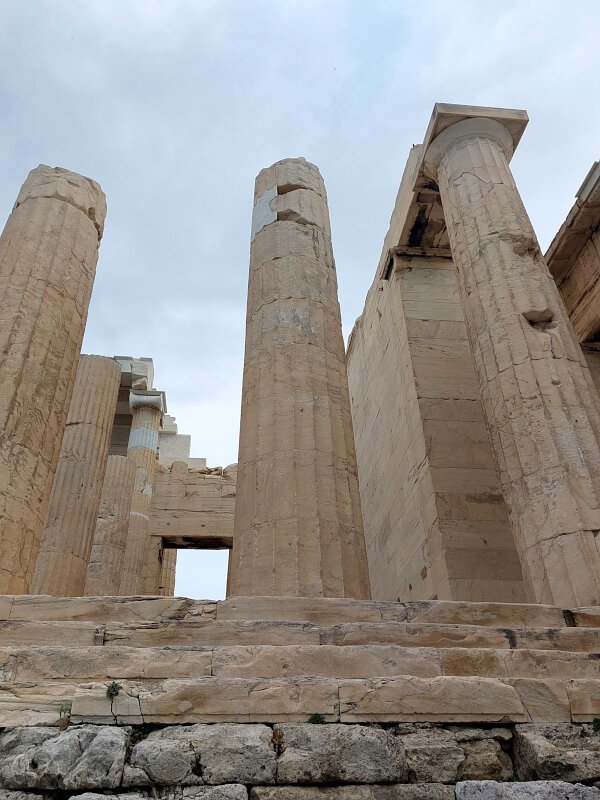
Propylaea of the Acropolis
Monumental gateway to the Athenian Acropolis
Country: Greece
Date: 2023
Place: Acropolis, Athens
437–432 BCE
Classical Greek — Doric and Ionic style
Designed by Mnesikles
!Built during the age of Pericles, the Propylaea was the principal monumental entrance to the Acropolis. Its construction was interrupted by the outbreak of the Peloponnesian War, leaving the ambitious complex unfinished.
Looking upward from the ancient steps, massive fluted marble columns frame the entrance to the Acropolis. The Propylaea formed a ceremonial transition from the city below to the sacred hilltop sanctuary, with its impressive stonework designed to convey grandeur and order.
New addition
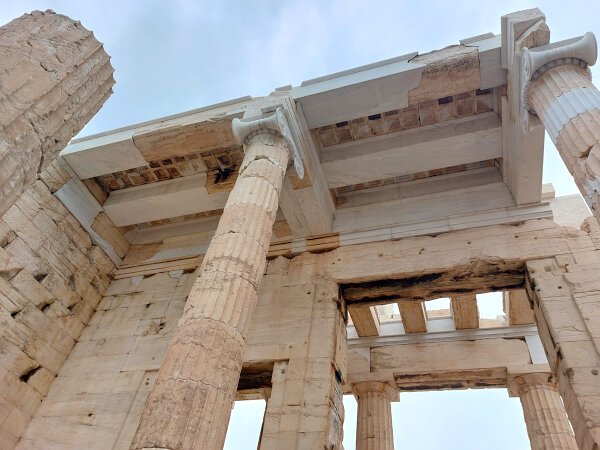
Propylaea — Ionic Columns and Ceiling
Ionic capitals and coffered marble roof structure
Country: Greece
Date: 2023
Place: Acropolis, Athens
437–432 BCE
Classical Greek — Doric and Ionic style
Designed by Mnesikles
!The gateway combines Doric exterior colonnades with taller Ionic columns inside its central passage. Its sophisticated marble beam and ceiling arrangement is an outstanding example of fifth-century BCE Greek architectural engineering.
An upward view inside the Propylaea reveals the spiral volutes of Ionic column capitals, the heavy marble lintels and the geometric coffers of the ceiling. Ancient surviving blocks can be distinguished from lighter replacement stone used during conservation work.